
Published geometry
Diameter, thickness, crystal plane, scratch-dig, clear aperture, parallelism, and flatness are listed against every part number, so the comparison happens before the RFQ.
Clear aperture is published at 90% on every stock size
Every stock part number publishes its own diameter, thickness, crystal plane, scratch-dig, clear aperture, parallelism, and flatness. Use the stock line when the housing can accept one of them. If the drawing controls custom geometry, edge work, coating, or documentation, move directly to Custom Sapphire Components.

Stock windows exist for the case where the housing can accept a published size, and hand off cleanly to custom when it cannot.
Diameter, thickness, crystal plane, scratch-dig, clear aperture, parallelism, and flatness are listed against every part number, so the comparison happens before the RFQ.
Clear aperture is published at 90% on every stock size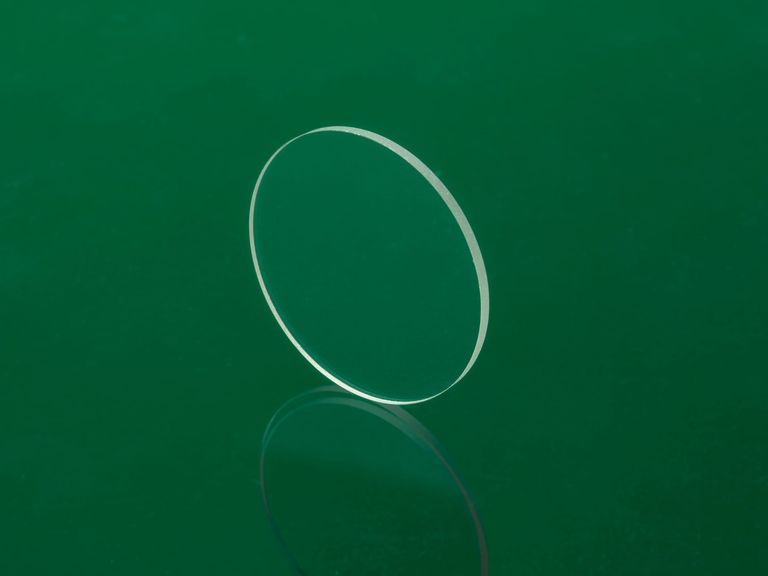
Sapphire resists scratching, wear, heat, and chemical attack while transmitting from the ultraviolet into the mid-infrared, the reason it replaces glass in abrasive and high-temperature apertures.
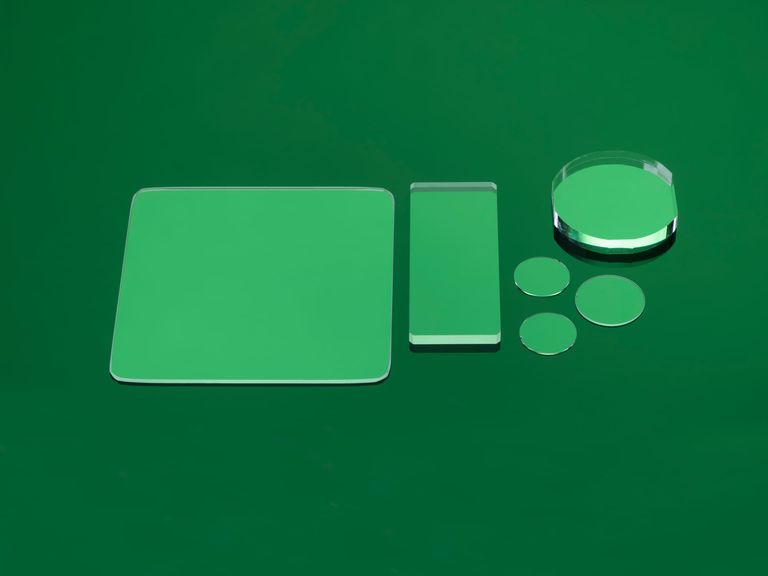
Start optical, sensor, or environmental testing without waiting for custom tooling, then hold the design decision until the test data is in.
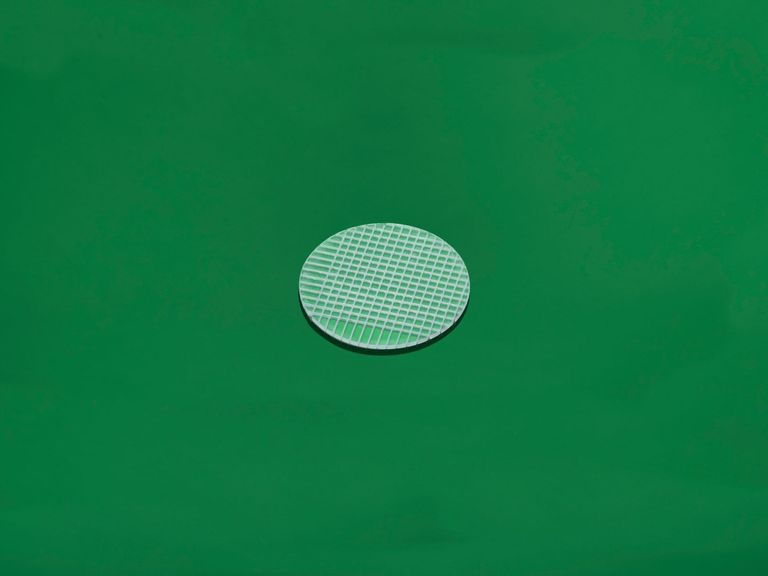
When the design freezes and the print starts controlling geometry, finish, coating, or documentation, the same team carries it into custom sapphire fabrication.
Custom windows run up to 8″ diameterThese are IRD's published capability limits across materials and geometries, not a grade every part ships to. Open the process that controls your critical surface and quote against that one.
These are the published stock ranges. Read the part number for the exact combination, the grades are not interchangeable across diameters.
| Attribute | Typical | Best case |
|---|---|---|
| Diameter25.4 mm, 31.75 mm, and 38 mm are stocked | 25.4 mm | 38 mm |
| ThicknessBoth thicknesses appear across the size range | 1.0 mm | 3.0 mm |
| Scratch / dig80/50, 40/20, and 20/10 are published | 80/50 | 20/10 |
| Parallelism3 arc min on the 25.4 mm × 1.0 mm windows only | 3 arc min | 3 arc sec |
| Flatness at 633 nm8 λ, 2 λ, 1 λ, 1/2 λ, and 1/4 λ per inch by part number | 1 λ per inch | 1/4 λ per inch |
| Clear aperturePublished on every stock part number | 90% | 90% |
The published table is the specification. These are the four things worth reading off it before a stock window gets designed into an assembly.
The published options run from 80/50 through 40/20 to 20/10 across the same three diameters. If the aperture sits in an imaging or laser path, the scratch-dig grade matters more than the diameter, and the price difference between grades is published alongside it.
The stock table lists c-axis material on the 25.4 mm and 38 mm windows and randomly oriented material on the 31.75 mm windows. Orientation is part of the specification, not an interchangeable detail.
The published figures span 8 λ per inch down to 1/4 λ per inch. A window that is adequate as a protective cover may be nowhere near adequate in a transmitted wavefront, and the table is explicit about which is which.
IRD created its sapphire stock window program to make sapphire a practical alternative to fused silica where debris shields and cover lenses are replaced often. Sapphire costs more up front and lasts materially longer, which is a total-cost argument rather than a unit-price one.
IRD's published materials, coating, and inspection equipment lists.
The answers an applications engineer would give you on the first call.
Start a quoteRead the part number rather than the headline. The best stock flatness is 1/4 λ per inch at 633 nm, on the 25.4 mm 40/20 part numbers. Others are published at 1/2 λ, 1 λ, 2 λ, and 8 λ per inch, the range across the stock line is wide.
Three diameters, 25.4 mm, 31.75 mm, and 38 mm, in 1.0 mm and 3.0 mm thicknesses. Parallelism is published to 3 arc seconds on every stock part number except the 25.4 mm × 1.0 mm windows, which are listed at 3 arc minutes. Confirm current availability at quote.
IRD's quoting checklist: application, product type, volume potential and schedule, material, dimensions, surface quality, coatings, assembly, cleaning, and packaging. Attach the drawing. For a new design the technical team runs a no-cost Design for Manufacturability review before quoting, then estimates prototype and production volumes separately.
No. IRD manufactures to your print or performance requirement and contributes material, process, and manufacturability input, the design stays with your team. When a print calls for tighter tolerances than the application requires, IRD will flag the potential over-specification, since it can add unnecessary cost. Final optical design decisions remain yours.
Machining runs to 30″ × 16″ × 16″, polishing to 36″ diameter, grinding to 24″ diameter at 6″ height, lapping to 13.3″ diameter, waterjet to 40″ × 24″ × 2″, and dicing to 8″ diameter at .300″ thick. Larger geometry is quoted against whichever process controls the critical surface.
IRD applies basic anti-reflective and metallic coatings in-house for quick turnaround. Other coating requirements are handled through select, vetted coating partners. Name the coating target in the RFQ and the team will confirm the route before quoting.
IRD is registered with the Directorate of Defense Trade Controls, and controlled programs are manufactured and stored domestically across the Litchfield and Alexandria, Minnesota facilities. Both plants operate under quality systems certified to ISO 9001:2015 and ISO 13485:2016 for ultra-high-precision glass, optical, and ceramic components.
Packaging is tailored to the part and can include multi-layer foam, custom corrugated packaging, gel packs for sensitive optics, and military-grade cases. Components are supported on edges or non-critical surfaces outside the clear aperture and held against shifting in transit.
Use these IRD references when reviewing stock sapphire windows requirements.
IRD's national sales manager on synthetic sapphire's properties, where it earns its cost against glass, and how to select a grade and orientation for the application.
RecordingTechnical articleThe total-cost case behind the stock program: where BOROFLOAT® and sapphire replace fused silica debris shields, and why sapphire's higher initial price can still come out ahead on replacement frequency.
ArticleTechnical articleHow synthetic sapphire is grown, cut, ground, and polished into windows, and what its strength means against quartz and conventional glass at a fraction of the thickness.
Article
Quote from the table: give the part number, or the diameter, thickness, crystal plane, scratch-dig, flatness, and quantity you need. If nothing on the table fits, send the aperture, environment, and transmission requirement instead and the team will scope the custom route. For a new custom design, the Design for Manufacturability review is free of charge.
Or call 320.693.7217 to confirm current stock, pricing, and lead time before you design around a part number.